
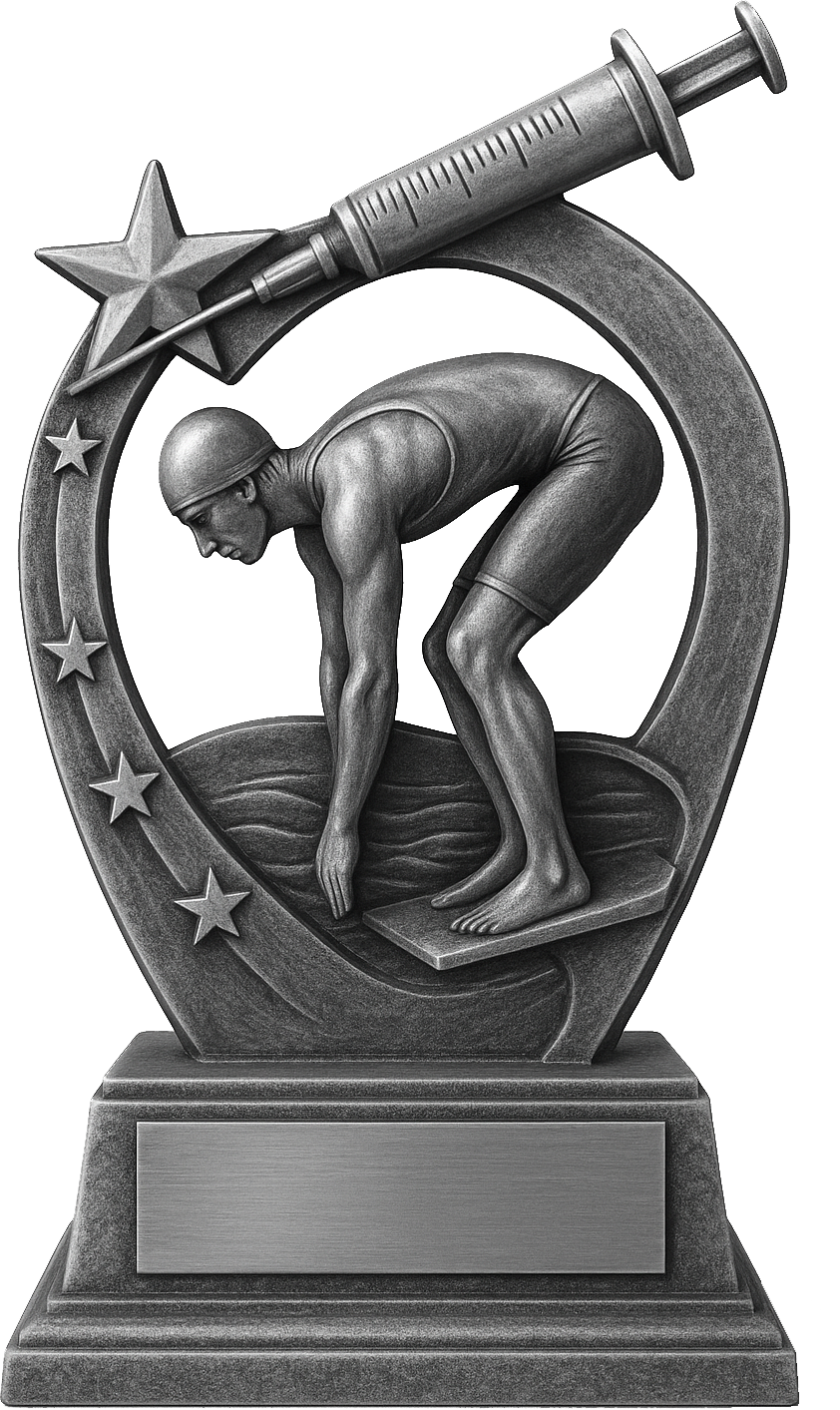
So. The Enhanced Games are done. Las Vegas has been returned to its natural state – a place where money is extracted from optimistic people under flashing lights – and we are left to pick through the wreckage of whatever it is we just watched. A sports event? A drug fair? A very expensive Instagram campaign with lanes? All three, probably, but mostly the last one.
Let us begin with the headline, which the Enhanced Games have been flogging like a medieval town crier who also owns the apothecary. Kristian Gkolomeev, they triumphantly announced, swam the 50m freestyle in 20.81 seconds – faster than the official world record. A million dollars was handed over. Champagne happened. The press release practically wept with joy.
One small detail – or possibly a large one, depending on your view. Social media has not been kind to the record claim. A number of users circulated video clips purporting to show that when the clock displayed 20.81, Gkolomeev had not yet reached the wall. Others have pushed back, pointing out – not unreasonably – that timing systems and video footage don’t always sync perfectly, a phenomenon that has been noted in Olympic races too. The Enhanced Games have not, at time of writing, offered a detailed technical rebuttal. Watch the clip, make up your own mind. What is beyond dispute is that the record is not recognised by World Aquatics, and never was going to be. But the story ran. The brand trended. The record claim embedded itself into the global news cycle like a particularly tenacious earworm. Whether or not the swim was everything it was billed as, the Enhanced Games had already got what they came for.
This is, you will notice, the entire business model.
The Enhanced Games were not created to advance sport. They were created to sell you peptides. The founders have financial interests in the performance-enhancing compounds they spent months enthusiastically press-releasing at anyone who’d listen. The Games were always, at base, an extended advertisement – an infomercial with a starting pistol, a shop front with a scoreboard, a drugs company that decided the most cost-effective route to market was to rent a Vegas pool and invite some Olympians.
And here’s the thing about cynical genius: it works. This particular operation has been extraordinarily effective. Whatever you think of the ethics, the marketing has been some of the finest snake-oil salesmanship since a gentleman in a waistcoat convinced the American frontier that his bottled tonic cured lumbago, dropsy, and mild disappointment.
The Enhanced Games understood something that traditional sport has spectacularly failed to grasp: that controversy is not the enemy of visibility.
It is visibility.
Now, the part where the entire premise collapses in on itself like a particularly dramatic soufflé.
The majority of events at the Enhanced Games – the competition specifically designed to celebrate and normalise performance-enhancing drugs – were reportedly won by athletes who had chosen not to take performance-enhancing drugs. The “non-enhanced” competitors, competing under a rulebook built around the philosophy of definitely take drugs, mostly beat the ones who did.
Let that breathe for a moment.
The Enhanced Games spent two years arguing that PEDs are an untapped frontier of human possibility – a legitimate scientific toolkit that the stuffy establishment was simply too frightened to embrace. Their own results then suggested, rather awkwardly, that elite athletes are mostly elite because of talent, training, and grinding commitment. Not what’s in the syringe. Someone might want to have a quiet word with their own data.
Now, the athletes. This matters, so pay attention.
The people who competed – many of them underpaid, under-recognised professionals who have given decades of their lives to their sport – are not the villains of this story. We live in a world where an elite swimmer might dedicate fifteen years to their craft and struggle to cover their training costs while the organisations governing their sport negotiate television deals worth hundreds of millions. If the Enhanced Games put serious money in the pockets of people who genuinely deserved it, that is not nothing. We are not in a position to tell athletes how to earn their living, and we should be very careful about the self-righteousness with which some of us reach for that particular stone.
The problem is not the swimmers in the pool. The problem is the people who built the pool, and what they whispered to every impressionable young person watching.
Because here is the lasting damage that no amount of creative video analysis can quantify. The Enhanced Games beamed, at scale, a single message to an audience that included a great many people who are not yet thirty and are still forming their understanding of what sport means, what achievement means, what the body is for. That message was: chemistry is the edge that separates the good from the great. Science can get you over the line. The establishment doesn’t want you to know this, but we’re telling you anyway, and also here is our website.
This is not a philosophy. It is a sales pitch. And it is a deeply corrosive one, arriving at precisely the moment when youth sport is already fighting a losing battle against shortcuts, quick fixes, and the relentless algorithm-driven promise that there is always a faster route to the top.
The Enhanced Games leadership had a genuine opportunity to do something interesting with the real problems in elite sport – financial exploitation, governing body dysfunction, the grotesque economics of amateurism. Instead they built a drug shop with a stadium attached and declared it progress.
Sport, at its best, is the most straightforward lie we tell ourselves: that effort is rewarded, that the best person wins, that the race is fair. It is not always true. But the aspiration matters enormously. The Enhanced Games took that aspiration, valued it at approximately nothing, and flogged the naming rights.
One final thought. A philosophical hand grenade, if you will.
The Enhanced Games have no publicly documented gender eligibility policy for their female category. None. Which raises a question their founders have conspicuously not answered: what happens when a biological male turns up at the registration desk, declares himself a woman, and dives in?
This is not a hypothetical designed to be unkind about transgender athletes. It is a stress test of the Enhanced Games’ own ideology. Because the entire enterprise was built on two pillars: bodily autonomy and self-determination. The individual, they told us, has the sovereign right to modify and optimise their body however they choose, free from institutional interference. Who is the establishment to tell you what you can and cannot put in your body? Who are they to set the boundaries of human performance?
Well. Quite. But here’s the problem. The moment the Enhanced Games write a policy excluding a biological male from the female category on the basis of biology, they have performed an act of institutional gatekeeping so profound it would make World Aquatics blush. They would be invoking the very biological essentialism they spent two years mocking. The stuffy establishment, it turns out, had a point.
Their three options, none of them good: allow it, and watch their female prize money get collected by a biological male while their first signed female athlete – who specifically joined after citing the Enhanced Games as a place where female athletes are “valued and compensated fairly” – looks on in justifiable fury. Refuse it on biological grounds, and spend the next six months explaining why bodily self-determination only applies to the bits of biology they approve of. Or scramble to produce a retroactive eligibility policy, which would look like precisely the kind of panicked institutional rule-making they built a brand out of attacking.
It is, as philosophical implosions go, a fairly spectacular one. The Enhanced Games are hoisted, comprehensively, by their own petard. They just haven’t had to confront it yet.
Remarkable, in its way. Absolutely, comprehensively wrong.
Back